
There was a time when you could reasonably expect a national government to comport itself with marginally more sobriety than an anonymous social media account – the kind that is often adorned with the avatar of an ape. That expectation was touchingly naive.
There they were, in all their glory: the governments of Italy, of Finland, of Sweden, nations that have given the world the Renaissance, the concept of functional social democracy, and furniture you assemble yourself. They were now reduced to reacting extempore to videos they had encountered on the internet. These were not intelligence briefings or diplomatic cables or satellite reconnaissance, but the sort of material your uncle might forward at two in the morning with a subject line that’s entirely in capital letters.
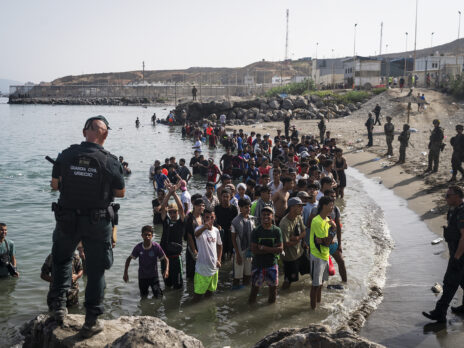
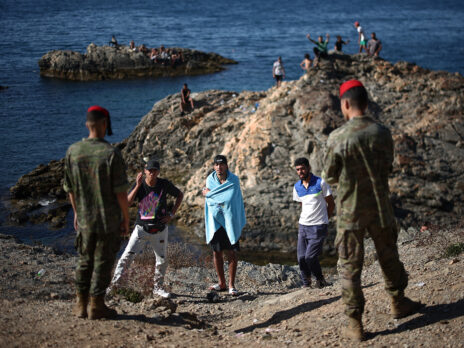
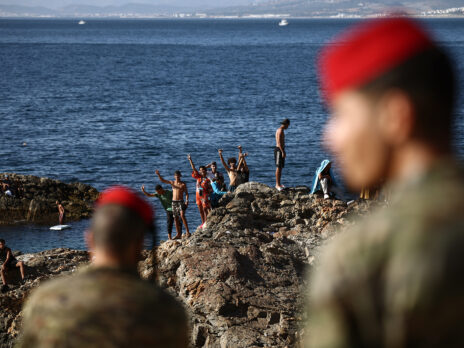
The videos were filmed thousands of miles to the south, on the rocky shores of Ceuta in late July, where roughly 60,000 Moroccans, most of them young, had broken through the border and entered the Spanish enclave. Any observer with functioning eyes could see that this was no ordinary migration wave. The great columns arriving in Ceuta carried nothing with them: no bundles, no ragged rucksacks, none of the pitiful cargo of the genuinely displaced. They moved collectively with the eerie coordination of a body answering to a single command.
It did not seem to matter that the scene on Ceuta’s shores invited questions of an entirely different order – European capitals were in no mood for thinking. They shrieked incoherently and publicly about the coming Armageddon, and the need to enter doomsday prepper mode. Here, they announced, was the prophesied invasion: the unwashed masses of Africa and the Middle East, arriving at last, to vindicate every fevered pamphlet and every midnight broadcast of the far right. Never to be outdone, Reform’s Robert Jenrick announced that “these men are on their way to Calais”. Elon Musk pronounced it a “zombie apocalypse”, an aside so execrable it achieved the rare feat of lowering a discourse already conducted in the gutter.

And the response of many European politicians? Tacitly concurring, they demanded action: push back the masses, and by whatever means necessary.
In the meantime, Spain should be excluded from Schengen and borders shut down – something impossible under European law, but promised all the more swiftly for it by the Italian prime minister, Giorgia Meloni. It so happens that Ceuta is not part of Schengen to begin with. Does Meloni know that? Or was she, under the August sun, thinking of Marbella?
The terror from European capitals came mixed with an unmistakable note of schadenfreude. For some time already, Spain and its prime minister, Pedro Sánchez, had been a source of acute annoyance to his peers across the continent – and, of course, in Washington. While the Spanish leader spoke freely and dauntlessly of the horrors in Gaza, his counterparts fled from the facts with all the alacrity of men and women saving their careers, which is precisely what they thought they were doing again this time. While Spain has absorbed large numbers of immigrants into its fast-growing economy, much of the rest of Europe has stagnated under an ever-thickening fear of the future.
While Sánchez met Xi Jinping several times a year, they trembled at the thought of what Donald Trump might make of these intimacies. While Sánchez presciently called out the Iran disaster the very day the war was launched, Germany’s chancellor, Friedrich Merz, was trying on his best clothes for the victory parade, saying some days later during a visit to Washington that now was not the time “to lecture our partners and allies” on whether the attack complied with international law. How dare Spain make him look like a fool. Sánchez had even become something of a global figure, lionised across the Middle East and Africa for the rarest of contemporary political talents: the ability to stand before Trump without stooping.
Spain, a Nato member, had declined to raise its defence spending to the levels demanded by Washington, thereby earning the ire of Trump, who threatened to expel the country from the alliance. But the charge of pacifism, so eagerly circulated by Madrid’s critics, is demonstrably false. The heresy is not that Spain doesn’t care about defence; it is that it wants a European defence, with a European army, no less, equipped by a European arms industry, with the procurement orders flowing to Madrid and Toulouse and Turin rather than to northern Virginia.
Here was a model standing in complete and public contradiction to the Trumpian worldview, with its demand for militarisation on American terms and its civilisational ideology of the barred gate. At the very moment most of Europe was hauling up the drawbridge, Spain was lowering it deliberately with a massive regularisation plan for migrants and a pragmatic argument attached: the country needed immigration to grow, to arrest its demographic decline, to keep its welfare state solvent.
But now, at last, was the chance to put Sánchez in his place. Chaos in Spain would not merely prove their fears were well-founded. It might, with luck, finish Sánchez altogether. When King Henry II wanted to see off Thomas Becket, he merely needed to express his frustration – “Will no one rid me of this turbulent priest?” – and the defiant archbishop of Canterbury was duly killed. The method has lost none of its utility in the eight and a half centuries since that famous sentence was uttered: one need not command an outcome if one can simply create the weather for it.
Incredibly, within minutes and hours of the videos circulating, the European right, the massive Trump propaganda machine and Israeli officials such as the envoy to the United Nations Danny Danon had joined the chorus, raising the temperature, feeding the panic, hastening the crisis into bloom. Fox News announced that “northern Spain” had been invaded.
That the mass incursion at Ceuta was an organised hybrid attack is not a matter on which reasonable people can differ. Spanish security cameras caught officers of Moroccan intelligence salted in among the supposed migrants. There is verified footage of trucks ferrying the crowds to the frontier, and of uniformed agents shepherding them along like so many reluctant tour groups. But the evidence, though welcome, is almost a redundancy. Crowds of 60,000 do not assemble spontaneously anywhere on Earth, and least of all in Morocco, where the state security services take a proprietary interest in gatherings of around five.
This was, in short, a coordinated attack of precisely the kind Belarus mounted against Poland not so long ago. Poland, on that occasion, asked for help and received it, as was justified. Spain, on this occasion, asked for nothing and was punished anyway. The Polish prime minister, Donald Tusk, of all people, called for its isolation. Denmark, not to be outdone, responded to the assault on Spain by impatiently instructing it to take “the necessary measures” – like someone watching a neighbouring house burn and complaining about the smoke. The response raises the question: when the hybrid assaults on Greenland begin, as they will, shall Spain return the courtesy? Shall Madrid demand that Copenhagen take the “necessary measures”? Europe, it turns out, has finally achieved a common foreign policy: every man for himself.
I have watched a good deal of political folly in my time, but this was qualitatively different. For what unfolded represented no political view, no political project, nothing that could dignify itself with the name of politics. The governments of Italy and Finland and Sweden, among several others, may flatter themselves that they are opposing the left, that their movement carries some coherent ideology in its saddlebags. But it carries nothing of the kind. Open those bags and out spills only disaggregation and collapse.
Consider the substitutions European leaders have made, each one a swindle. In place of political reason and articulable goals: frenzy and emotion, the politics of the raised pulse. In place of political projects: personal animosity and the settling of scores elevated to statecraft. In place of the slow, unglamorous work of building institutions and understanding, pure destruction. And here lies the true cost of the abandonment. Because the effort to think has been ceded, there remains nothing on which European unity might be built. No principles, since principles require the discipline of thought. No enlarged perspective, since enlargement demands some objectivity, and what most of Europe has shown is that it will treat similar crises very differently depending on their distance from home. What is left is the parochial and the personal: the grievance, the grudge, the midnight post.
Since the incursion was never a migration but a manoeuvre, it ended as such things do: on command. Not one migrant has yet set foot on mainland Spain: within a day, after intense diplomacy between Madrid and Rabat, 48,000 migrants were returned to Morocco. But more than a hundred of those attempting to enter Ceuta had died, human beings deployed as ammunition and then abandoned as debris.
The operation wound down before most of Europe’s governments had even begun to comprehend what it was. They were still bracing themselves for a wave that had already receded. The tide went out while they were still drowning in it. Presented with an aggressor, the continent went looking for a culprit and found… itself. Just as Trump and Musk and Reform would have scripted it, the fault belonged to Europe – which is to say to Spain, which is to say to Sánchez.
No one should mistake the ebb for the end. Morocco sees the situation clearly. Emboldened by its deepening compact with Trump, a fruit of the 2020 Abraham Accords, which saw it finally recognise Israel in return for American support for its claim over the Western Sahara, it has begun to dream, no longer so idly, of Ceuta as well as the city of Melilla on the North African coast.
And why not? Across nine miles of water, imagine what Morocco spies: a continent that cannot distinguish shadow from substance, a union that has been seized by cycles of panics and vendettas, and a political class that responds to a probe of its defences by demanding the punishment of the country probed.
For that is the fact that ought to keep serious people awake: an external assault was launched against Europe, whatever its motives and planning, and large portions of its own political elites took the side of the assailant. Out of ignorance, mostly. Out of careerism, reliably. But mostly out of a poverty of intellect, of fibre, of any experience of the world deeper than a screen.
One might have expected the wreckage of two decades of emergencies – from the eurozone crisis to the migrant crisis in 2015, from Brexit to Ukraine – to forge something stable, adversity being, as every national mythology insists, the bedrock of character. Instead, it has left Europe weak and hollow. The old fantasy held that Europe was a sleeping giant, needing only a sufficient shock to wake it. The shocks have come and left us with ruins.
Bruno Maçães is a New Statesman foreign correspondent and author of Geopolitics for the End Time: From the Pandemic to the Climate Crisis (C Hurst & Co)
Content from our partners


Related
This article appears in the 05 Aug 2026 issue of the New Statesman, Europe's shame
Join the debate
Subscribe here to commentThis is brilliant, passionate and informative in ways most media coverage has not been: what we saw in Ceuta was not another unregulated wave of desperate refugees, and EU governments should have had the wit to point this out and respond accordingly I agree that Spain’s naturalisation initiative has riled other governments, but perhaps they should also note that Spain’s economy is growing fast and make more of an effort to demonstrate – on the ground, not de haut en bas – the benefits of controlled immigration, without which the UK’s NHS for one would already have collapsed.
The NHS would only collapse without immigration because we choose not to train our own people. Incidentally, those who come in on that basis are quite capable of diffusing out of the NHS into other jobs once any conditions expire and indefinite leave to remain is granted, re-creating NHS staff shortages whose filling requires – guess what? – yet more immigration. That’s even more true of the low-paid care sector of course. And if mass immigration were really the route to the sunlit uplands, doesn’t the scale of mass immigration over the last 20 years suggest that Britain should now be a nirvana? – rather than the threadbare and divided place it has become? Blair’s decision to allow Eastern European immigration with no cooling-off post-accession period was one of the most disastrous mistakes made by any politician, and it infuriates me that the Labour party expects me to tramp the streets delivering leaflets trying to drum up support (which I grudgingly do, being a sucker for moral blackmail) when it has lost so much through this gratuitous misjudgement.
“and large portions of its own political elites took the side of the assailant.” Sophistry of the first order. Just because the political elites of Europe blamed Spain for the crisis, does not mean that these same elites supported and took the side of Morocco.
Surely they did so effectively by blaming Spain. This is not sophistry at all. And the wider point – European solidarity collapsed – is spot-on, as is the Greenland warning.
Disordered as the response has been from the EU capitals, it is intelligible in that the fear must be of another accretion of support to the insurgent populist parties (even the populist Meloni has this to fear). And perhaps the true cause of the reaction was not the “invasion” of Ceuta, but Spain’s naturalisation initiative. Ultimately, EU elites have to listen to their own national electorates, and lectures de haut en bas never go down too well.
Spain’s foolish decision to grant citizenship to those who entered the country illegally before a given (recent) date has inevitably created the expectation that those who migrate illegally now will gain citizenship from some similar amnesty in a few years. We would not encourage benefit or tax fraud like that, so why do it for illegal immigration? And the point of course is that even though we have left the EU and therefore those with new Spanish passports can’t come to Britain as would have been their right before, with the British people debarred by EU ‘Freedom of Movement’ from exercising any democratic control over who comes to our country, they will become part of the more general problem of the influx into Europe from the third world. Bruno Macaes is too focussed on liberal point-scoring to address these realities, and his article is an opportunity wasted.
Pope Leo couldn’t have said it better. US Catholic Social Services lost over 3 Billion (yes billion US dollars) tax payer money (Biden) over three years paid for their efforts to lure, house, feed and relocate foreign citizens, in US alone. Rome has been unhappy with the Thump for his lack of charity. The Pope now says he’s on the 60,000 African immigrants into Cueta side.
If anyone “shrieked incoherently and publicly” it’s those like Leo or the US Congress woman Balint from Vermont, the latter on Youtube who said we need migrants to ‘wipe our asses’. I recently volunteered for four semesters teaching English as Second language to a class of Mexican and Mexican Americans. They fear the immigrant invasions more than anyone as it undercuts what little income they have and the taxes they pay for “wiping our asses.” One of their Mexican nephews drove into a tree after a seventeen hour day roofing for cash, and it took months before my class raised enough money to send the body back to Mexico. It is cheap sophistry, or worse, for governments and businesses to lure foreign citizens with someone else’s money to the West for back-breaking labor, cheap sex, ballots or worse, and then drape yourself in charity. The Western media sure makes it all sound so progressive.
It may very be that ‘Uncle’ had it right, and you had it wrong
Macaes is one of the leftist imbeciles who have destroyed Europe.
He is no position to lecture Europe about anything.